







The Brain Does Not See Reality. It Negotiates With It.

Table of contents
The most persistent illusion in human history may also be the most convincing one. Almost everyone believes they experience the world directly.
Light enters the eyes. Sound reaches the ears. Molecules activate receptors inside the nose and tongue. Pressure stimulates the skin. The brain receives this information, assembles it, and presents reality exactly as it exists.
It feels obvious because it is effortless.
It is also almost certainly incomplete.
Modern neuroscience increasingly describes perception not as passive observation but as active construction. Long before conscious awareness emerges, the brain has already generated predictions about what it expects to encounter. Incoming sensory information is then compared with those predictions, and perception becomes the brain’s best current explanation of the causes behind its sensory signals rather than a literal recording of the external world.
This distinction changes the meaning of perception itself. You do not simply see reality. You experience your brain’s most convincing negotiation with reality.
That negotiation determines far more than vision. It influences confidence, emotion, pain, attention, learning, creativity, social judgment, and nearly every decision you will make today.
Perhaps the greatest limitation of human intelligence is not that we know too little.
It is that we rarely notice where prediction ends and perception begins.
Perception Begins Before Information Arrives
Imagine walking into your own home after years of living there. You move through familiar rooms almost automatically. Objects appear exactly where you expect them to be. The environment feels stable because your brain has already predicted almost everything it is about to encounter.
Now imagine entering an unfamiliar laboratory in complete darkness.
Every sound suddenly becomes important. Every movement demands attention. Every unexpected sensation carries uncertainty. The difference is not the amount of information reaching your senses. It is the amount of prediction available before the information arrives.
The brain constantly attempts to minimize surprise. It constructs internal models of the world and updates those models only when incoming evidence differs enough to justify revision. Most of the time, perception succeeds because prediction succeeds.
Reality is therefore experienced through expectation. Not after expectation.

The Energy Economy of Perception
The human brain represents only about two percent of body weight, yet it consumes roughly twenty percent of the body’s resting energy.
Evolution could not afford a system that analyzed every photon, every vibration, every odor, and every movement independently.
Instead, the nervous system developed something more efficient. Prediction.
If most of the environment remains stable, the brain only needs to process what changes. Everything else can be inferred. This means that perception is partly an energy-saving strategy.
The more accurately the brain predicts its environment, the less computational work it must perform.
But efficiency has a cost.
When predictions become too rigid, perception itself becomes less flexible.
We stop noticing alternatives. We overlook information that contradicts our expectations. We become increasingly convinced that we are seeing reality exactly as it is, when in fact we are seeing reality as our model expects it to be.
Intelligence Is Not the Opposite of Bias
One of the most dangerous assumptions in modern culture is that intelligence protects people from cognitive bias.
Evidence suggests something more complicated.
Intelligent individuals often become exceptionally skilled at defending existing models.
The same cognitive ability that allows a scientist to build an elegant theory can allow another person to construct an equally elegant justification for never changing their mind.
The limitation is not intelligence.
It is model flexibility.
A powerful predictive system that refuses revision becomes increasingly detached from reality, regardless of how sophisticated it appears.
The future may therefore belong less to those who accumulate information than to those who update their internal models more rapidly than everyone else.
Knowledge matters.
Updating matters more.
Attention Determines What Reality Becomes
Every second, your sensory systems receive vastly more information than conscious awareness can process. The brain solves this impossible problem through selection. Attention is not simply concentration. It is exclusion.
Every object you consciously notice represents thousands that remained invisible. Every thought you entertain displaced countless others that never reached awareness.
In practical terms, attention functions as the editor of reality.
What receives sustained attention becomes psychologically significant. What repeatedly escapes attention slowly disappears from conscious experience altogether, regardless of whether it remains objectively important.
This may explain why two people can leave the same meeting believing entirely different conversations occurred.
They occupied the same room.
They inhabited different realities.
The New Frontier of Cognitive Performance
Most nootropics have historically been evaluated according to simple questions.
Can they improve focus?
Can they increase memory?
Can they reduce fatigue?
Useful questions.
Incomplete questions.
A more interesting possibility is emerging. Perhaps the greatest determinant of long-term cognitive performance is not how much information enters the brain, but how effectively the brain updates its model of reality.
The fastest learner is not necessarily the one who memorizes the most. It may be the one who abandons outdated assumptions the earliest.
In that sense, intellectual humility becomes a biological advantage.
Changing your mind is metabolically expensive.

The WUKIYO Perspective
Human performance begins long before productivity. It begins with perception.
Every decision, every conversation, every creative breakthrough depends upon the quality of the model through which reality is interpreted. If that model becomes rigid, no amount of motivation can fully compensate. If it remains adaptive, learning accelerates because the brain becomes increasingly willing to replace outdated predictions with better ones.
This philosophy influences how WUKIYO approaches cognitive support.
WUKIYO | esse reflects the belief that sustained cognition emerges from a well-supported nervous system rather than a single pathway or isolated ingredient. The objective is not to manufacture intelligence, but to help support the biological foundations upon which learning, attention, and flexible thinking depend.
Periods requiring exceptional cognitive precision may call for a different strategy.
WUKIYO | apex was developed for moments in which focused mental engagement matters most. Attention cannot guarantee insight, but without stable attention the brain has little opportunity to recognize when an existing model deserves revision.
No supplement replaces curiosity.
No formulation creates wisdom.
No capsule can perform the difficult work of questioning deeply held assumptions.
Those remain uniquely human responsibilities.
The role of intelligent supplementation is not to replace that process. It is to support the biological system capable of carrying it out.

The Most Dangerous Illusion
The greatest illusion is not believing something false. It is believing that you are seeing reality exactly as it is.
Every prediction the brain makes is both a strength and a potential blind spot.
Without prediction, perception would become impossibly slow.
Without revision, perception gradually becomes detached from reality. Human intelligence exists in the tension between those two forces.
The brain must predict confidently enough to survive. Yet remain humble enough to change. That may be the deepest lesson emerging from modern neuroscience.
Reality is not simply discovered.
It is continuously negotiated.
And the quality of your life depends, in part, on how willing your brain is to renegotiate yesterday’s certainty in light of today’s evidence.
Key Takeaways
Perception is increasingly understood as an active process in which the brain combines sensory input with predictive internal models rather than passively recording reality.
Prediction reduces computational demand and allows the brain to operate efficiently, but rigid predictions can limit learning and adaptation.
Intelligence alone does not eliminate bias. The ability to revise internal models may be more important than the ability to defend them.
Attention determines which parts of the environment become psychologically meaningful, making it one of the most influential mechanisms shaping subjective reality.
Long-term cognitive performance depends not only on acquiring information but also on updating beliefs when evidence changes.
WUKIYO | esse supports the biological foundations required for sustained cognition, while WUKIYO | apex complements periods of deliberate cognitive engagement in which attention and mental precision are especially valuable.
The future belongs not only to those who know more, but to those whose minds remain capable of changing more accurately than everyone else’s.
Related products

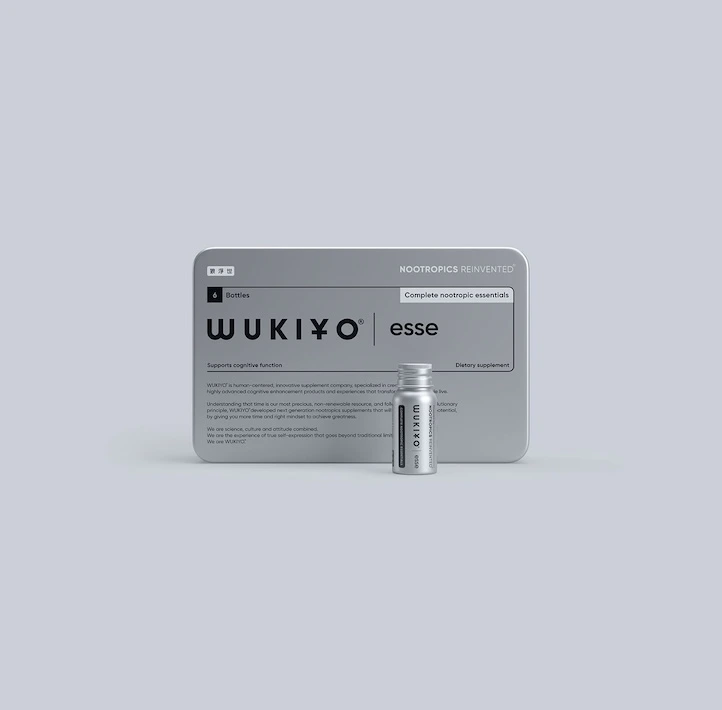
Complete
nootropic essentials
Complete nootropic
essentials

Buy 2 Items | Get 10% Off.
$54 USD $45 USD


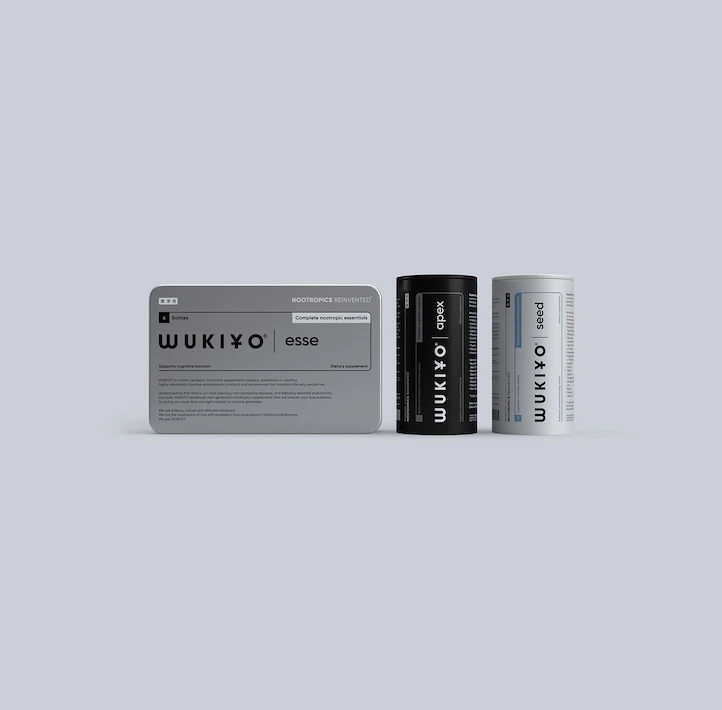
Precision
cognitive enhancer
Precision cognitive
enhancer
Buy 2 Items | Get 10% Off.
$99 USD $84 USD

The Complete
Mind and Body
The Complete
Mind and Body
Buy 2 Items | Get 10% Off.
$234 USD $199 USD


The
Limitless
The Limitless
Buy 2 Items | Get 10% Off.
$135 USD $115 USD

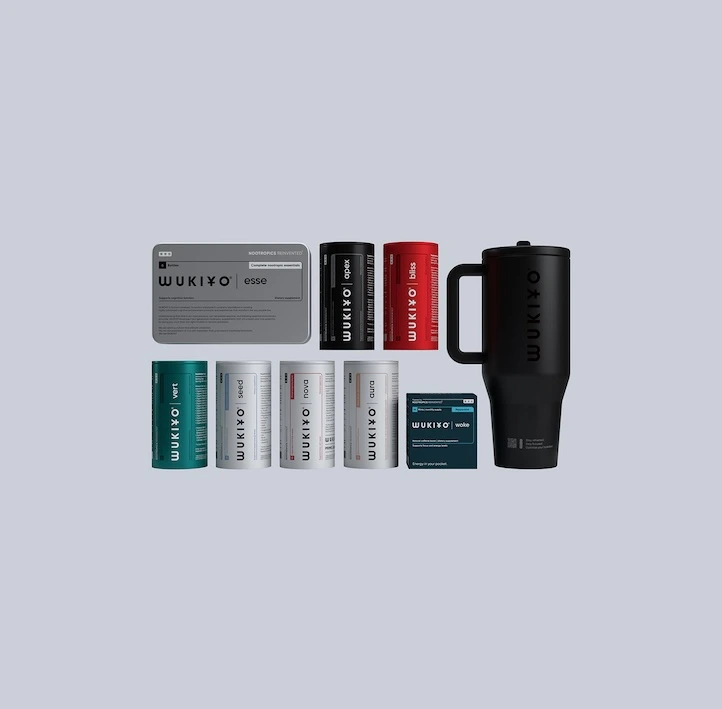
Ultimate
WUKIYO® Experience
Ultimate WUKIYO®
Experience
Buy 2 Items | Get 10% Off.
$786 USD $693 USD
Other posts
October 12, 2026
The Drug With No Molecule: When Sound Starts Controlling the Brain
September 28, 2026
The Next Nootropic May Help You Forget

September 21, 2026
Inside the Wild Biohacking Underground: The Compounds People Are Using Before Science Catches Up

September 14, 2026
WUKIYO | apex and the End of the Single-Pathway Nootropic

September 7, 2026
You Are Not Tired. Your Brain May Be Spending Energy Wrong.

August 31, 2026
The Brain Does Not See Reality. It Negotiates With It.

August 24, 2026
Memory Was Not Designed to Preserve the Past. It Was Designed to Build the Future.

August 10, 2026
The Brain Was Never Built to Think. It Was Built to Predict.

July 27, 2026
The Energy Hypothesis: The Hidden Rule Behind Human Behavior, Perception, and the Future of Cognitive Freedom

July 20, 2026