Why Some of Your Most Important Thoughts Appear When You Stop Trying to Think
Table of contents
- The Brain Never Really Goes Offline
- The Executive Brain Has Excellent PR
- Creativity May Be a Network Negotiation
- Incubation: When Failure Keeps Working
- Your Hippocampus Is a Remix Machine
- The Computational Value of Being Inefficient
- Boredom May Be an Interface
- The Salience Problem
- Flow Is Not God
- Genius Sometimes Begins by Getting Lost
- AI Changes the Value of Wandering
- Nootropics Have a Problem Here
- WUKIYO | apex Is Not an Identity
- The Most Advanced Optimization May Include Deliberate Uselessness
- Stop Optimizing Every Minute
- The Brain Needs Territory You Do Not Control
- The WUKIYO Thesis
- The Useless Brain
- Key Takeaways
We have spent decades teaching the brain to behave. Focus. Concentrate. Eliminate distraction. Enter flow. Track output. Optimize attention. Make every hour useful. The modern high-performance mind is expected to operate like a precision instrument, pointed toward an objective and protected from anything that does not contribute to it. It sounds intelligent. It may also be incomplete. Because some of the most important thoughts you will ever have may arrive precisely when you stop trying to produce them. In the shower. During a walk. Looking through an airplane window. Minutes before sleep. Halfway through a conversation about something completely unrelated. The solution appears after you abandoned the problem. The sentence arrives after you stopped writing. The connection becomes obvious only after conscious effort failed. We call these moments inspiration because we do not really know what else to call them. Neuroscience offers a more unsettling possibility. Your brain may have continued working after “you” stopped. And if that is true, one of modern optimization culture’s deepest assumptions begins to fracture. Perhaps cognition is not at its most intelligent when consciousness controls every second of it. Perhaps sometimes intelligence requires getting out of its own way.
The Brain Never Really Goes Offline
For a long time, neuroscientists studying the brain concentrated on what happened when people performed tasks. Read this. Remember that. Move your finger. Solve the equation. Identify the image. The experimental logic was straightforward. Give the brain something to do, observe which regions become more active, and begin mapping function. But something strange became increasingly difficult to ignore. When the task stopped, the brain did not simply become silent. Certain regions became highly organized in their activity. This constellation eventually became associated with what we now call the default mode network, or DMN. The name almost undersells it. “Default” sounds passive. Background. Idle. Yet the network is implicated in autobiographical memory, imagining future scenarios, self-referential processing, social cognition, constructing narratives and forms of spontaneous thought. The brain at rest was not necessarily resting. It was doing something else. This changed the question. Instead of asking what the brain does when we give it a task, neuroscience could begin asking: What does the brain choose to do when we stop telling it what to do? That may be one of the most interesting questions in cognitive science.
The Executive Brain Has Excellent PR
Modern productivity culture overwhelmingly favors one side of cognition. Executive control. Working memory. Goal maintenance. Inhibition. Selective attention. The ability to keep the correct information active while suppressing irrelevant interference. These capacities are enormously valuable. Without them, complex civilization would become difficult. But usefulness created a mythology. We began treating executive control as though it were synonymous with intelligence itself. It isn’t. The brain contains systems associated with internally directed cognition, systems involved in detecting what is salient, and executive-control systems that help maintain task goals. Their relationships are dynamic rather than simply competitive. And this is where creativity becomes neurologically inconvenient. Creative thought appears to require capacities that seem contradictory. Generate unusual possibilities. Then judge them. Wander. Then select. Associate freely. Then impose structure. Loosen control. Then recover it. A brain permanently locked into rigid executive control may therefore be exceptionally efficient while remaining intellectually predictable. It can pursue the target. But who decided the target was correct?
Creativity May Be a Network Negotiation
There is no single creativity center hidden somewhere behind the forehead. That would have made things easier. Instead, creative cognition appears to involve interaction among multiple large-scale networks, including systems associated with spontaneous internal thought and executive control. That matters. Because the romantic idea of creativity says: release control. The corporate idea says: apply discipline. The brain may require both. One system helps produce candidate associations. Another helps determine which are useful. One expands the possibility space. Another collapses it. One asks, “What if?” Another asks, “Does this survive contact with reality?” Creativity may emerge not from either state winning, but from the ability to move between them. This produces a more interesting definition of intelligence: Intelligence may partly be the ability to know when not to be intelligent in the conventional sense. When to stop forcing. When to let associations drift. When to permit irrelevant material into consciousness. When to tolerate an unresolved problem long enough for another configuration to emerge. Then, critically, when to return. Because endless wandering is not creativity either. It is wandering. The architecture matters.
Incubation: When Failure Keeps Working
There is an old experience almost everyone recognizes. You attack a problem. Nothing works. You keep pushing. Still nothing. Eventually you give up. You cook. Walk. Exercise. Sleep. Talk to someone. Then the answer appears. Psychology has a name for part of this phenomenon: incubation. Periods away from deliberate problem-solving can sometimes improve subsequent performance on creative problems. Why? There is no single settled mechanism. That uncertainty makes the phenomenon more interesting, not less. Breaking from a problem may reduce fixation on an incorrect strategy. Competing associations may weaken. Memory processes may continue reorganizing relevant information. Attention may encounter cues elsewhere that become useful. Spontaneous cognition may create combinations deliberate search failed to reach. In other words, stopping conscious work does not necessarily mean the cognitive process has stopped. It may mean control has changed hands.
Your Hippocampus Is a Remix Machine
Memory is often imagined as storage. Experience enters. Memory files it. Later, the brain retrieves the file. Real memory is stranger. Remembering is reconstructive. Fragments are reassembled. Context changes retrieval. New information can alter old memories. The hippocampal system participates not only in remembering previous experience but also in constructing possible futures. This makes evolutionary sense. Memory is valuable not because the past deserves an archive. Memory is valuable because the past can be recombined to predict what might happen next. That means imagination and memory are not opposites. They are relatives. When the mind wanders, fragments that were never consciously meant to meet can suddenly occupy the same cognitive space. A conversation from three years ago. Something read yesterday. A visual pattern. A failed project. A smell. An unresolved question. A completely unrelated idea. Most combinations are useless. That is precisely the point. Exploration is expensive because most exploration fails. But occasionally two previously distant representations collide and create something neither contained alone. We call the result originality. The brain may call it recombination.
The Computational Value of Being Inefficient
This creates a fascinating contradiction. Efficiency is excellent when the destination is known. If you know exactly what problem must be solved and exactly what success looks like, efficient cognition is extraordinarily valuable. But what happens when the correct destination is unknown? Optimization becomes dangerous. An optimizer requires an objective. Give it the wrong objective and it may become brilliantly efficient at producing the wrong future. Human cognition faces the same problem. A perfectly optimized mind may become exceptionally good at reaching destinations it already knows exist. But invention frequently requires discovering destinations that were never specified. That requires exploration. Exploration contains dead ends. Waste. Wrong associations. Boredom. Uncertainty. Periods that produce nothing measurable. From the perspective of productivity, these moments look defective. From the perspective of search, they may be computationally necessary. Cognitive inefficiency may sometimes be computational exploration. That is not permission to become chronically distracted. It is recognition that efficiency and discovery solve different problems.
Boredom May Be an Interface
Modern life has almost eliminated empty cognitive space. The elevator arrives and the phone appears. A queue forms and the phone appears. Dinner pauses and the phone appears. A conversation ends and the phone appears. You enter bed and the phone follows. Every unoccupied interval can now be filled before spontaneous thought has time to develop. This is historically bizarre. For most of human existence, the mind regularly encountered periods without engineered information arriving from outside. Now the external world can colonize virtually every gap. The result is not merely “too much screen time.” Something subtler may be happening. We are outsourcing the initiation of thought. Instead of allowing the brain to determine what comes next, an algorithm provides the next object of attention. Again. Again. Again. Boredom becomes almost intolerable because boredom is the moment external direction disappears. But perhaps that discomfort is not evidence that nothing is happening. Perhaps it is the transition period before internally generated cognition takes over. We may be medicating every moment of cognitive silence with content. Then wondering why original thought feels scarce.
The Salience Problem
Of course, the brain cannot simply oscillate randomly between focus and wandering. Something has to determine what deserves control. This brings us toward another important network involved in detecting behaviorally relevant events and helping coordinate shifts between modes of processing: the salience network. The exact neuroscience is more complicated than the simplified diagrams circulating online, but the larger principle is useful. Advanced cognition depends not only on having multiple states available. It depends on switching appropriately between them. Focus when focus matters. Internal simulation when external attention can loosen. Alertness when something important changes. Executive control when a candidate idea needs testing. The intelligence may therefore reside partly in the transition. Not focus. Not wandering. Switching. This extends the argument we made in The Stack Is Dead. There is no universally optimal cognitive state. But now we can go further. There may not even be an optimal state worth maintaining. The advantage may lie in cognitive range.
Flow Is Not God
Performance culture turned flow into something close to a secular religion. Lose self-consciousness. Merge action and awareness. Become completely absorbed. Execute without friction. Flow can be extraordinary. But the cultural obsession with flow sometimes confuses one exceptional state with the universal objective of cognition. Flow is especially compelling when skill and challenge are aligned and the individual is deeply engaged in execution. But invention does not always feel like flow. Discovery can feel terrible. Confusing. Fragmented. Slow. Uncertain. An hour can produce nothing. A day can appear wasted. A week can contain one useful sentence. The desire to remain continuously “in flow” can therefore become another attempt to make cognition aesthetically pleasing. But breakthrough thought does not owe us a pleasant subjective experience. Sometimes intelligence feels like mastery. Sometimes it feels like being lost.

Genius Sometimes Begins by Getting Lost
Consider what deliberate expertise does. It compresses. An expert sees patterns a novice cannot because years of learning have made certain interpretations rapid and automatic. That is powerful. It also creates a danger. Expertise can make familiar interpretations arrive too easily. The brain becomes excellent at seeing what it has learned to see. Radical innovation occasionally requires violating that compression. Looking at the familiar object incorrectly. Entertaining the amateur question. Following an association that a disciplined expert would normally suppress. Temporarily refusing the obvious answer. This is why intellectual play matters. Why interdisciplinary thinking matters. Why conversations outside one’s field matter. Why travel can matter. Why art can influence science and science can influence design. Novelty perturbs the predictive system. It introduces material the existing model cannot immediately compress. Most of it goes nowhere. Some of it changes the model. Genius sometimes begins by getting lost. The important part is knowing how to return with something.
AI Changes the Value of Wandering
Now the argument becomes more urgent. Artificial intelligence is rapidly reducing the cost of many forms of structured cognition. Summarization. Classification. Translation. Search. Formatting. Routine analysis. Conventional ideation. Pattern extraction across enormous datasets. Execution within clearly specified constraints. This does not make human cognition obsolete. It changes what becomes scarce. When competent answers become cheap, unusual questions become more valuable. When conventional variations become instantaneous, taste becomes more valuable. When machines can traverse enormous known possibility spaces, the human capacity to create strange connections between distant domains may become more economically significant, not less. The irony is extraordinary. At exactly the moment machines become increasingly efficient, humans are attempting to make themselves behave more like machines. More scheduled. More measurable. More predictable. More optimized. More continuously productive. Perhaps we have the strategy backward. The future human advantage may not come from competing with machines at relentless cognitive efficiency. It may come partly from protecting the forms of cognition that efficiency tries to eliminate. Ambiguity. Taste. Curiosity without immediate utility. Embodied experience. Intuition. Play. Obsession. Dreaming. And the ability to follow a thought before knowing whether it deserves to exist.
Nootropics Have a Problem Here
This creates an uncomfortable question for the nootropics industry. What exactly are we enhancing? If every product promises focus, drive, attention and productivity, are we quietly constructing a pharmacological monoculture of cognition? A brain permanently optimized for execution might become extremely useful. Useful to employers. Useful to deadlines. Useful to metrics. Useful to systems already capable of defining the objective. But usefulness is not synonymous with intelligence. And productivity is not synonymous with originality. This is why the future of nootropics cannot be permanent focus. A sophisticated cognitive philosophy must preserve more than the ability to lock onto a target. It must preserve the ability to question the target.
WUKIYO | apex Is Not an Identity
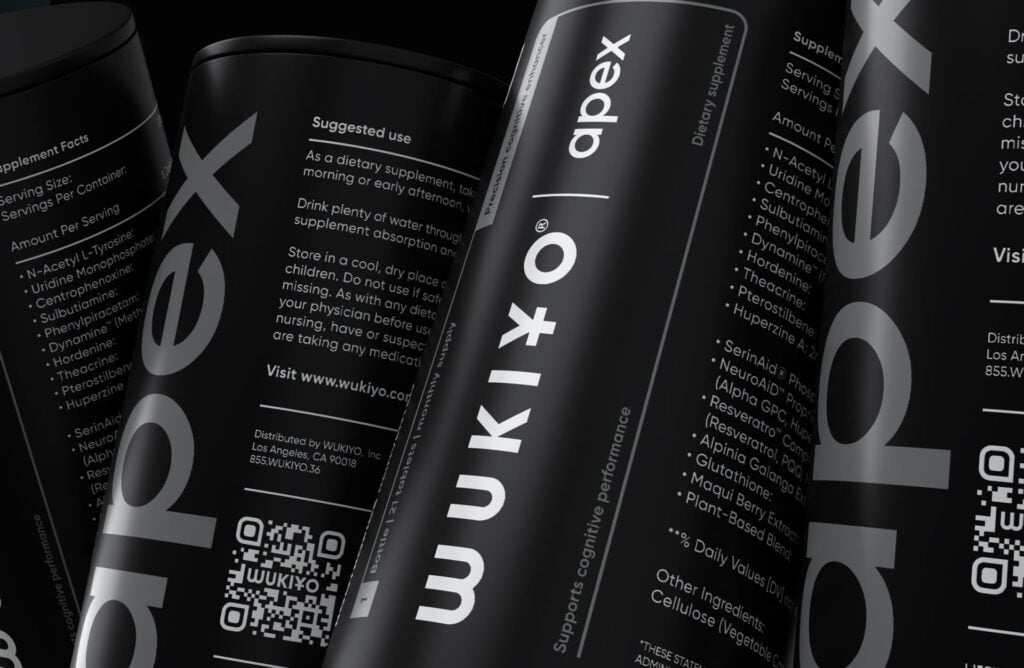
This is where WUKIYO | apex should be understood carefully. Apex represents directed cognition. There are moments when attention needs to narrow. When the noise needs to disappear. When execution matters. When an idea has already been found and now has to survive contact with reality. That state is valuable. But it is not where a human being should permanently live. Apex is a state tool. Not an identity. WUKIYO’s larger philosophy cannot be “always focused.” That would contradict the biology we claim to respect. The objective is access. Access to focus when focus matters. Access to recovery when recovery matters. Access to exploration when the problem has no obvious solution. Access to intensity without becoming dependent on intensity. Access to silence without immediately needing to fill it. This is cognitive sovereignty from another direction. Not maximizing one state. Protecting the ability to move.
The Most Advanced Optimization May Include Deliberate Uselessness
Imagine scheduling an hour with no measurable objective. To productivity culture, this sounds absurd. No podcast. No inbox. No scrolling. No educational content. No attempt to “use the time wisely.” Walk. Sit. Look. Think if thought appears. Do not force it if it doesn’t. At first, the nervous system may demand input. That reaction itself is information. Then something else can begin. Old material resurfaces. Problems reconnect. Memory fragments appear. Internal dialogue changes. Nothing useful may happen. That possibility must be permitted. Because the moment unstructured cognition is required to produce a measurable return, it stops being unstructured. This is the paradox. You cannot optimize wandering without eventually destroying the thing you were trying to optimize. Some cognitive territory must remain economically useless long enough to become intellectually valuable.
Stop Optimizing Every Minute
There is a broader cultural mistake hiding here. We increasingly treat human life as a dashboard. Sleep score. Readiness score. Steps. Calories. Heart-rate variability. Deep-work hours. Tasks completed. Books read. Meditation streak. Screen time. Biological age. Everything becomes visible. Visibility creates measurement. Measurement invites optimization. Optimization creates objectives. Objectives change behavior. Often this is useful. But what happens to the parts of life whose value cannot be recognized immediately? The conversation that goes nowhere. The book outside your field. The afternoon without output. The strange hobby. The wrong turn. The thought you cannot monetize. The person who contradicts your worldview. The idea that initially embarrasses you. Optimization culture risks eliminating precisely the anomalies from which new models emerge. Not everything valuable announces its value at the moment it occurs.
The Brain Needs Territory You Do Not Control
This may be the deeper conclusion. Consciousness likes to imagine itself as the executive. It sets the objective. Directs attention. Makes decisions. Evaluates results. But much of cognition occurs outside conscious access. Memories consolidate without permission. Associations form without instruction. Emotional information alters judgment before explanation arrives. Solutions sometimes appear before we understand how they were generated. The intelligent response is not to romanticize the unconscious. It is to stop pretending conscious control deserves a monopoly. The brain may need territory we do not continuously supervise. Mental wilderness. Places where thoughts can mutate before being evaluated. Where associations can form before utility kills them. Where the system can explore without immediately reporting productivity. The point is not less intelligence. It is a larger definition of intelligence.
The WUKIYO Thesis
The first era of cognitive optimization asked how to focus harder. The next should ask when focus is appropriate. Then something even more difficult: When should focus be surrendered? This is where WUKIYO’s philosophy becomes larger than nootropics. We are not interested in turning human beings into permanently optimized productivity machines. Machines will become better at being machines. The opportunity is to understand the range of states from which exceptional human cognition emerges. Focus. Recovery. Exploration. Execution. Silence. Intensity. Play. Sleep. Attention. Wandering. None is universally superior. The architecture lies in movement between them. WUKIYO | esse supports the terrain. WUKIYO | apex exists for deliberate cognitive direction. But neither replaces the human intelligence required to know what state the moment demands. That decision remains yours. It should remain yours. Because the future of cognitive enhancement is not a brain permanently switched on. It is a brain capable of changing gears without losing the driver.
The Useless Brain
Perhaps we named the problem incorrectly from the beginning. Mind-wandering is not necessarily failed focus. Boredom is not necessarily failed stimulation. Incubation is not necessarily failed work. Silence is not necessarily empty. And a thought without immediate utility is not necessarily useless. The brain evolved long before calendars, productivity software, notifications and quarterly objectives existed. It contains modes of cognition whose value cannot always be measured on demand. We should be careful before optimizing them away. Because the thought that changes your company may arrive while you are not working. The solution to the problem may appear after you stop solving it. The connection nobody else sees may begin as an association you almost dismissed. And the future you eventually build may first appear during a moment that looked, from the outside, like absolutely nothing was happening. A perfectly optimized mind may become exceptionally good at reaching destinations it already knows exist. But humanity has never advanced only by reaching known destinations faster. Someone had to wander far enough to discover another one. Sometimes the most productive thing your brain can do is become temporarily useless.
Key Takeaways
• The brain remains highly organized during periods without externally directed tasks; internally oriented networks participate in memory, self-referential processing, future simulation and spontaneous cognition.
• Creativity does not appear to belong to a single brain region or network. It can involve dynamic cooperation between systems associated with spontaneous thought, executive control and the detection of salient information.
• Productive cognition requires more than focus. Generating possibilities and evaluating them can demand different neural configurations, making the ability to transition between states potentially more important than permanently maintaining one.
• Incubation suggests that stepping away from a difficult problem can sometimes improve subsequent creative performance. Conscious effort may stop while memory restructuring, associative processes and release from fixation continue to alter the problem space.
• Memory is reconstructive rather than a perfect archive. The brain can recombine elements of previous experience to simulate possibilities that have never occurred.
• Cognitive efficiency is extremely valuable when the destination is known. When the destination itself must be discovered, exploration, uncertainty and apparently inefficient thought may become computationally useful.
• Boredom should not automatically be interpreted as cognitive failure. Constant external stimulation may occupy mental intervals that could otherwise allow internally generated thought to emerge.
• Flow is an important cognitive state, not the universal ideal. Execution, invention, reflection, exploration and recovery can require profoundly different mental conditions.
• Expertise increases efficiency by allowing the brain to recognize familiar patterns rapidly, but radical originality can sometimes require escaping those same established interpretations.
• As AI makes structured and conventional cognition increasingly inexpensive, unusual questions, interdisciplinary associations, taste, curiosity and exploratory thinking may become more valuable human capabilities.
• A nootropic philosophy built exclusively around permanent focus risks optimizing only one dimension of cognition. Greater focus is not automatically greater intelligence.
• WUKIYO | apex should therefore be understood as a tool for directed cognitive states rather than an identity built around permanent stimulation or productivity.
• WUKIYO’s broader objective is cognitive range: access to focus when focus matters, recovery when recovery matters, and exploration when the correct answer does not yet exist.
• Not every valuable mental state can or should be optimized around immediate measurable output. Some forms of cognition require space in which usefulness is temporarily irrelevant.
• Cognitive sovereignty is not permanent control over the mind. It is the ability to move intelligently between control and release.
• The future of human performance may depend not only on becoming better at concentrating, but on protecting the mental territory from which unexpected thoughts can emerge.
• A perfectly optimized mind may become extraordinarily efficient at reaching known destinations. Human progress also requires minds capable of discovering destinations nobody knew existed.
• Sometimes the most productive thing your brain can do is become temporarily useless. There is no universal cognitive state called “better.” Different tasks require different balances of vigilance, flexibility, memory, inhibition, creativity and persistence.
Related products


Precision
cognitive enhancer
Precision cognitive
enhancer

Buy 2 Items | Get 10% Off.
$99 USD $84 USD


Complete
nootropic essentials
Complete nootropic
essentials
Buy 2 Items | Get 10% Off.
$54 USD $45 USD


Ultimate
WUKIYO® Experience
Ultimate WUKIYO®
Experience
Buy 2 Items | Get 10% Off.
$786 USD $693 USD


The
Limitless
The Limitless
Buy 2 Items | Get 10% Off.
$135 USD $115 USD


The
Magic Mushrooms
The Magic
Mushrooms
Buy 2 Items | Get 10% Off.
$156 USD $129 USD


The
Mind Mastery
The Mind
Mastery
Buy 2 Items | Get 10% Off.
$234 USD $199 USD
Other posts
November 16, 2026
Why Some of Your Most Important Thoughts Appear When You Stop Trying to Think

November 9, 2026
What the Nootropics Underground Accidentally Discovered About the Future of Human Cognition

October 12, 2026
The Drug With No Molecule: When Sound Starts Controlling the Brain

September 28, 2026
The Next Nootropic May Help You Forget

September 21, 2026
Inside the Wild Biohacking Underground: The Compounds People Are Using Before Science Catches Up

September 14, 2026
WUKIYO | apex and the End of the Single-Pathway Nootropic

September 7, 2026
You Are Not Tired. Your Brain May Be Spending Energy Wrong.

August 31, 2026
The Brain Does Not See Reality. It Negotiates With It.

August 24, 2026
Memory Was Not Designed to Preserve the Past. It Was Designed to Build the Future.

August 10, 2026