


What the Nootropics Underground Accidentally Discovered About the Future of Human Cognition

Table of contents
- The Underground Laboratory
- The Inverted-U Nobody Wants to Sell
- Stop Thinking in Neurotransmitters
- The Grammar of the Synapse
- Orexin and the End of Crude Wakefulness
- The Compound Is Only Half the Experiment
- Ketones, Creatine and the Metabolic Brain
- The Most Dangerous Word in Biohacking Is “Stack”
- The Brain Always Sends an Invoice
- Chronopharmacology: The Same Molecule Is Not the Same Event at 08:00 and 18:00
- The Missing Dimension: Task
- Natural Versus Synthetic Is a Childish Argument
- The Research-Chemical Problem
- The Stack Is Dead
- And This Is Why WUKIYO | esse Exists
- And This Is Why WUKIYO | apex Had to Be Different
- Adaptive Cognition
- The Final Nootropic May Be a Decision
- From Enhancement to Cognitive Sovereignty
- The WUKIYO Position
- Beyond the Stack
- The Final Mistake
- Key Takeaways
The history of cognitive enhancement may eventually be remembered as the history of humans misunderstanding what performance actually is. First, we wanted stimulation. Then dopamine. Then acetylcholine. Then glutamate. Then neuroplasticity. Then mitochondrial energy. Then stacks. Then increasingly elaborate combinations designed to make the machinery of cognition do more. For decades, the underlying assumption barely changed: if one desirable mechanism improves performance, manipulating several desirable mechanisms should improve it further. It was pharmacological addition. More wakefulness. More drive. More memory. More signal. More plasticity. More energy. But biology has an inconvenient relationship with the word more. More dopamine does not mean more intelligence. More glutamatergic activity does not mean better learning. More acetylcholine does not guarantee better memory. More cortical excitation does not create better computation. More wakefulness does not necessarily create better cognition. Even more plasticity, stripped of timing and control, is not automatically desirable. The brain is not an engine waiting for a larger turbocharger. It is a continuously adapting network trying to maintain functional order while conditions change around it. And that changes the entire nootropics conversation. The future of cognitive enhancement may not belong to the strongest compound. It may belong to the most intelligent state.
The Underground Laboratory
Long before wellness became polished, the nootropics underground was conducting an enormous uncontrolled experiment. Racetams. Choline donors. Eugeroics. Adaptogens. Ampakines. Dopaminergic compounds. Nicotinic agents. Mushroom extracts. Russian peptides. Experimental neurotrophic compounds. Mitochondrial substrates. Amino acids. Research chemicals with almost no meaningful human evidence. Combinations built from PubMed abstracts, pharmacology textbooks, forum reports and occasionally pure optimism. Some of it was sophisticated. Some of it was reckless. Some of it was pharmacologically interesting but clinically unconvincing. Some of it became mythology. And some of it pointed toward questions that mainstream wellness had barely learned to ask. The interesting part was never that the underground found the perfect stack. It didn’t. The interesting part was that thousands of people began probing cognition through completely different biological entrances and discovered, often accidentally, that cognition refused to behave like a single variable. A compound could improve vigilance while doing little for reasoning. Something could make a person feel intensely focused while making that focus less flexible. Wakefulness could increase while judgment remained unchanged. Memory could improve in one experimental domain and remain unaffected in another. A subjective sense of cognitive power could become dramatically stronger while objective performance moved only slightly. The deeper the experimentation went, the harder it became to defend the idea of a universal “better brain.” There is no better brain. There are better states for particular demands. That distinction changes everything.
The Inverted-U Nobody Wants to Sell
Neurobiology repeatedly produces a shape that marketing hates. The inverted U. Too little activity and performance suffers. Increase it and performance improves. Continue increasing it and performance eventually deteriorates. Catecholamine signaling in the prefrontal cortex is a classic example. Dopamine and noradrenergic systems participate in working memory, attention and executive function, but optimal cognition depends on regulation rather than maximal activation. This means the biological relationship between chemistry and performance is frequently nonlinear. A person beginning below an optimum may improve when a pathway is strengthened. A person already near the optimum may gain little. Push the same system further and performance may worsen. The molecule did not suddenly change. The starting state did. This may be one of the most important ideas in all of cognitive enhancement: Baseline is part of the drug. Sleep debt is part of the drug. Stress state is part of the drug. Genetics are part of the drug. Tolerance is part of the drug. Nutrition is part of the drug. Circadian phase is part of the drug. The task itself is part of the drug. The same intervention does not enter the same brain twice because the brain itself is moving. Once that is understood, the traditional nootropic question begins to look almost primitive. “What does this compound do?” The better question is: What does this compound do to this nervous system, in this state, performing this task, at this time, and what state does it leave behind? That is no longer supplement culture. That is state architecture.

Stop Thinking in Neurotransmitters
The popular language of nootropics is dominated by neurotransmitters. Increase dopamine for motivation. Support acetylcholine for memory. Modulate GABA for calm. Influence serotonin for mood. Work with glutamate for learning. Useful shorthand quickly becomes bad neuroscience when it implies that neurotransmitters have single jobs. They do not. A neurotransmitter is not a psychological function in molecular form. Dopamine is not motivation in a bottle. Acetylcholine is not memory. Serotonin is not happiness. GABA is not calm. Glutamate is not intelligence. These signaling systems operate through receptor subtypes, anatomical locations, firing patterns, downstream pathways, feedback loops and interactions with other networks. Location matters. Timing matters. Concentration matters. Receptor subtype matters. Network state matters. This is why modern neuropharmacology becomes far more interesting when it stops asking how to simply increase a transmitter and starts asking how signaling can be selectively modulated.
The Grammar of the Synapse
Consider AMPA receptors. They participate in fast excitatory neurotransmission and are deeply involved in synaptic plasticity. A crude interpretation would be obvious: if AMPA activity participates in learning, increase AMPA activity. But the sophisticated pharmacological frontier is subtler. Positive allosteric modulation can change how a receptor responds to its endogenous ligand rather than simply behaving like another direct agonist. The distinction is profound. One strategy shouts into the system. The other changes how the system listens. This is why allosteric modulation is so conceptually important to the future of neuropharmacology. It suggests that advanced pharmacology may increasingly operate not by replacing endogenous communication but by modifying its sensitivity, duration or context. The molecule becomes less like an instruction. More like punctuation. The same philosophical transition is appearing elsewhere. Metabotropic glutamate receptors offer another layer of control over excitatory signaling. Nicotinic receptor subtypes create different opportunities from simply “increasing acetylcholine.” Dopamine receptor families produce different downstream effects. GABAergic pharmacology becomes dramatically more complicated once receptor subtype and localization enter the conversation. The deeper you descend into neuropharmacology, the less convincing “more” becomes. Precision replaces magnitude.
Orexin and the End of Crude Wakefulness
Wakefulness provides an almost perfect example. For generations, pharmacological wakefulness largely meant manipulating systems downstream through stimulants and related agents. The subjective result could be powerful, but wakefulness, arousal, motivation and cognition were often treated as though they were interchangeable. They are not. Orexin biology points toward something more precise. Orexin neurons participate in stabilizing wakefulness and coordinating arousal. The development of selective orexin-2 receptor agonists is therefore scientifically fascinating because it targets machinery closer to the biological regulation of wake state itself. This is not merely “another stimulant.” It represents a different pharmacological philosophy. Rather than indiscriminately demanding more activation from the nervous system, medicine is learning to intervene in specific circuits responsible for specific states. That transition matters far beyond narcolepsy. It hints at where cognitive pharmacology may eventually go: not global activation, but state-specific control.

The Compound Is Only Half the Experiment
Take modafinil. Its reputation in enhancement culture became almost mythological. The limitless drug. The executive drug. The military wakefulness drug. The compound that supposedly turns an ordinary brain into something more. Controlled evidence is less cinematic. In healthy, non-sleep-deprived individuals, reported cognitive benefits are generally modest and domain-specific rather than transformational. Under sleep deprivation or impaired wakefulness, however, the value proposition changes because the baseline has changed. This is the pattern we should be paying attention to. A molecule can appear mediocre in one state and extremely useful in another because it is interacting with a constraint. The same conceptual issue appears with creatine. Creatine is not usually introduced as an exotic nootropic because it lacks theatricality. Yet phosphocreatine participates directly in cellular energy buffering. Cognitive research becomes particularly interesting when energetic demand is elevated, including conditions such as sleep deprivation. Again, the underlying principle appears. The intervention becomes more valuable when the variable it supports becomes limiting. This suggests a different interpretation of the entire field. Many compounds called cognitive enhancers may actually be constraint removers. They do not create superhuman cognition. They remove a bottleneck preventing existing cognition from expressing itself. That is a much less marketable sentence. It may also be much closer to the truth.
Ketones, Creatine and the Metabolic Brain
For decades, cognitive enhancement concentrated heavily on neurotransmission. The next frontier increasingly includes metabolism. This matters because neurotransmission is energetically expensive. Maintaining ion gradients is expensive. Action potentials are expensive. Synaptic transmission is expensive. Plasticity is expensive. The brain’s remarkable computational ability exists because an equally remarkable metabolic infrastructure pays for it. That means a neurotransmitter-first model of cognition may be incomplete. If the system lacks sufficient energetic flexibility, demanding additional computation without supporting the infrastructure beneath it is like overclocking a processor while ignoring the power supply. Research involving creatine and ketone metabolism is therefore fascinating not because either constitutes a universal cognitive miracle, but because both force the field to confront a deeper reality: cognition has an energy budget. Once that budget becomes part of the model, fatigue, attention, recovery and resilience stop looking like separate categories. They become different expressions of resource allocation.
The Most Dangerous Word in Biohacking Is “Stack”
The stack was born from a logical idea. If compound A helps one pathway and compound B helps another, perhaps A plus B produces something better. Sometimes combinations are rational. But stacking can quietly introduce a conceptual error. Mechanistic diversity is not the same thing as biological coherence. A stack can simultaneously push catecholamines, alter cholinergic tone, influence glutamatergic signaling, add metabolic substrates and suppress the unwanted edges of stimulation with another compound. On paper it looks sophisticated. In a living nervous system it may be pharmacological noise. This is because the brain responds. Receptors regulate. Transporters adapt. Gene expression changes. Sleep pressure accumulates. Homeostatic mechanisms oppose persistent deviation. The nervous system is not a passive recipient of the stack. It is another player. Every intervention creates a counter-intervention from biology. This is homeostasis. And homeostasis may be the force enhancement culture has underestimated most.
The Brain Always Sends an Invoice
Take enough of a stimulant and the acute effect is obvious. But the acute effect is not the entire effect. What happens to appetite? What happens to sleep onset? What happens to sleep architecture? What happens when catecholamine signaling returns toward baseline? What happens after repeated exposure? What happens to receptor sensitivity? What happens when the compound is absent? What happens to tomorrow? The nootropics world has traditionally measured the peak. Biology measures the curve. Onset. Magnitude. Duration. Adaptation. Offset. Recovery. Repeatability. The real cognitive output of an intervention is the area underneath that entire biological curve. A compound that gives 130 percent today and leaves 70 percent tomorrow may be inferior to one that gives 110 percent repeatedly without creating substantial debt. This is where the language of optimization needs to mature. Performance minus recovery cost is closer to performance than performance alone. The nervous system keeps accounts even when the user does not.
Chronopharmacology: The Same Molecule Is Not the Same Event at 08:00 and 18:00
Time is perhaps the most neglected ingredient in supplementation. The human body is rhythmic. Cortisol changes across the day. Melatonin changes. Core temperature changes. Insulin sensitivity changes. Sleep pressure changes. Gene expression changes. Enzyme activity changes. Receptor systems and behavioral responsiveness can change. Yet supplementation culture frequently behaves as though 08:00 and 18:00 are biologically interchangeable. They are not. Even a familiar compound such as caffeine exposes the problem. Its useful acute effects cannot be evaluated independently of dose, individual metabolism, timing and its potential interference with subsequent sleep. The intervention does not end when the subjective stimulation disappears. Its biological consequences continue. This suggests something more disruptive: The future of nootropics may not be primarily about discovering new ingredients. It may be about discovering when an ingredient should exist in the system at all. Dose matters. But timing may become equally important. The future of cognitive enhancement is not pharmacological power. It is biological timing.
The Missing Dimension: Task
Now add another variable. What are you trying to do? A surgeon performing a delicate procedure does not require the same cognitive state as a novelist developing an original metaphor. A fighter pilot does not require the same attentional architecture as a mathematician exploring an unresolved abstraction. A founder negotiating an acquisition does not require the same neural state as the same founder generating an entirely new business model. We use the word focus as though it describes one desirable state. It does not. Sometimes cognition needs narrowing. Sometimes it needs widening. Sometimes it needs persistence. Sometimes flexibility. Sometimes inhibition. Sometimes exploration. Sometimes extreme vigilance. Sometimes the strange, low-pressure associative state in which distant ideas suddenly connect. A universal “focus pill” therefore contains a conceptual contradiction. Optimize focus for what? The question should come before the chemistry.
Why Feeling It Is Almost Meaningless
This may be the most commercially inconvenient fact in the entire nootropics category. Consumers are trained to evaluate supplements through sensation. Did it hit? Did I feel focused? Did energy rise? Was there a buzz? Did motivation appear? But subjective intensity and objective cognitive performance are different variables. A person can feel extraordinarily productive while producing mediocre work. Confidence can increase without accuracy increasing proportionally. Wakefulness can improve while judgment remains unchanged. A substance can be biologically relevant without producing theatre. Pharmacology does not owe the consumer a sensation. The obsession with “feeling it” may actually have distorted product development. When immediate perceptibility becomes a commercial advantage, formulations are incentivized toward noticeable acute effects. But the most intelligent intervention may sometimes be the one that disappears into the system. No drama. No violent peak. No identity-changing rush. Just less friction. That is harder to sell. It is also more sophisticated.
Natural Versus Synthetic Is a Childish Argument
The nootropics world repeatedly divides itself into camps. Natural. Synthetic. Plant-based. Pharmaceutical. Ancient. Laboratory-made. Clean. Chemical. Biology recognizes none of these moral categories. A plant can manufacture potent neuroactive molecules. A laboratory can synthesize a highly selective compound. Natural molecules can be toxic. Synthetic molecules can be life-saving. A compound’s origin does not tell you its pharmacodynamics. The serious questions are different. What does it bind to? At what affinity? At what concentration? What are its active metabolites? What is its half-life? Does it cross the blood-brain barrier? What pathways change downstream? How large is the therapeutic window? What happens with repeated exposure? What evidence exists in humans? What uncertainty remains? What happens when it meets other compounds? That is the adult version of the conversation. WUKIYO should live there.
The Research-Chemical Problem
There is another uncomfortable truth. The underground often reaches molecules before the evidence does. A mechanism appears elegant. An animal study looks extraordinary. A compound acquires a reputation. Human experimentation begins. Then anecdotes compound faster than data. This creates a peculiar epistemological trap. Mechanistic plausibility becomes mistaken for efficacy. Preclinical evidence becomes translated into human certainty. Subjective experience becomes treated as controlled evidence. Forum consensus becomes its own citation system. The correct response is not to dismiss experimental pharmacology. It is to become more scientifically demanding. Interesting is not proven. Promising is not established. Biologically active is not necessarily beneficial. A receptor target is not an outcome. And an outcome measured once is not automatically safe to pursue repeatedly. The most advanced position is neither blind enthusiasm nor conservative dismissal. It is disciplined curiosity.
The Stack Is Dead
The stack is not literally disappearing. People will continue combining compounds. Clinicians will continue using combination therapies. Formulators will continue designing multi-ingredient products. What should die is the philosophy underneath the old stack. More mechanisms. More ingredients. More pathways. More perceived sophistication. The replacement is architecture. An architecture begins with the state. What biological condition exists now? What cognitive state is required? What is limiting that state? What intervention has evidence relevant to that limitation? What should not be changed? When should the intervention begin? When should it end? What debt could it create? How does the system return to baseline? Now we are no longer stacking ingredients. We are engineering conditions.
And This Is Why WUKIYO | esse Exists
At this point, WUKIYO | esse should make sense before its name even appears. If cognition depends on baseline state, then the first layer of enhancement cannot logically begin with force. It begins with terrain. The system requires nutritional sufficiency, metabolic support, resilience, recovery and the biological resources from which cognition is constructed. That is the philosophy of WUKIYO | esse. Not “take this and become superhuman.” Something more intelligent. Make fewer parts of the system limiting. This is why esse belongs below the acute performance layer. It is foundation before demand. Availability before expenditure. Biological readiness before cognitive ambition. The purpose of a foundation is not to be dramatic. The purpose is to make everything built above it more possible.
And This Is Why WUKIYO | apex Had to Be Different
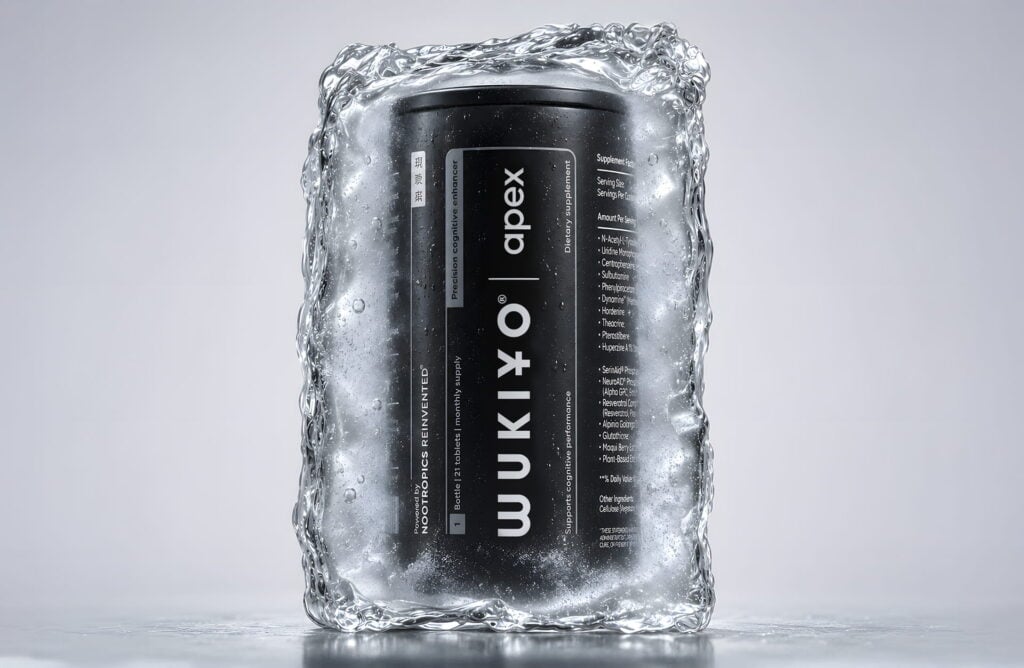
WUKIYO | apex begins where esse stops. Not at the level of basic biological readiness, but at the moment cognition is deliberately directed toward demand. This distinction matters. Apex should not be understood as “more esse.” Nor should it be understood as a louder stimulant. It belongs to a different state architecture. The objective is directed performance. Attention that remains available. Mental energy that can be allocated. Signal that does not need unnecessary noise around it. Cognitive intensity without making intensity itself the product. Esse asks: Is the system ready? Apex asks: Where are we directing it? That is the architecture. Foundation. Then direction. Not because two products look good in a portfolio. Because cognition itself operates hierarchically. You cannot sustainably demand precision from a system whose foundations are continuously compromised. And there is little value in building excellent biological readiness if that capacity cannot be deliberately deployed when life demands it. Esse and apex therefore represent two different answers. The first is about capacity. The second is about deployment. And that distinction may become increasingly important as cognitive enhancement evolves beyond the primitive language of “energy” and “focus.”
Adaptive Cognition
The logical endpoint of everything we have discussed is not a better stack. It is adaptive cognition. Imagine a future in which cognitive support is not static. Your sleep architecture is known. Your circadian phase is known. Your previous night’s recovery is known. Your metabolic state is known. Your heart-rate variability is known. Your cognitive workload is anticipated. Your recent stimulant exposure is known. Perhaps blood biomarkers, glucose dynamics, hormonal rhythms and individual pharmacokinetics become part of the picture as well. The question is no longer: What nootropic should I take? It becomes: What does this nervous system need now? That is a fundamentally different future. Some mornings the answer may be stimulation. Others may require metabolic support. Some states may benefit from increased alertness. Others may require reduced interference. Some tasks demand narrow attention. Others require associative freedom. Sometimes the highest-performance intervention may be an ingredient. Sometimes food. Sometimes light. Sometimes movement. Sometimes sleep. And sometimes the correct cognitive intervention may be nothing at all. That last possibility may be the hardest lesson for optimization culture to accept. Because a sufficiently intelligent system must eventually learn when not to intervene.
The Final Nootropic May Be a Decision
This is where artificial intelligence, wearable sensing, pharmacology and systems biology may eventually collide. Not in a magical capsule. In decision-making. As measurement becomes more continuous and individual biological baselines become better understood, supplementation could eventually move away from fixed daily assumptions toward increasingly adaptive strategies. The important breakthrough would not simply be discovering another molecule. It would be knowing when a molecule is appropriate. Knowing when it is unnecessary. Knowing when yesterday’s intervention has changed today’s baseline. Knowing when apparent underperformance is actually sleep debt. Knowing when declining focus reflects insufficient energy rather than insufficient stimulation. Knowing when the pursuit of greater performance has itself become the variable degrading performance. At that point, cognitive enhancement becomes less about pharmacological accumulation and more about biological interpretation. The intelligence moves upstream. The compound is no longer the entire product. The decision becomes part of the product.
From Enhancement to Cognitive Sovereignty
There is a deeper reason this matters. The purpose of nootropics should not be to create a human being who requires chemistry to access themselves. That would be dependence disguised as optimization. The more interesting objective is cognitive sovereignty. The ability to access attention when attention matters. To generate intensity without permanently living in intensity. To recover without guilt. To move between narrow focus and broad creativity. To recognize when fatigue contains information. To know the difference between a limitation that should be challenged and a biological signal that should be respected. The highest form of optimization is not permanent enhancement. It is range. A nervous system capable of changing state without losing itself. That is a more demanding definition of performance than simply being switched on. It is also more human.
The WUKIYO Position
This is the territory WUKIYO should occupy. Not the strongest stimulant. Not the largest ingredient panel. Not the loudest promise. Not pseudoscientific certainty wrapped around experimental compounds. And not the opposite extreme of pretending that meaningful cognitive enhancement is impossible. The interesting territory exists between those positions. Evidence without intellectual timidity. Experimentation without recklessness. Performance without biological denial. Natural compounds without naturalistic mythology. Synthetic pharmacology without worshipping novelty. Curiosity disciplined by evidence. Ambition disciplined by physiology. WUKIYO | esse and WUKIYO | apex belong inside that philosophy because they represent an architecture rather than a race for maximal intensity. Esse creates terrain. Apex creates direction. Neither should replace sleep, nutrition, movement, recovery or intelligent behavior. Neither needs to. The point is not to replace the human system. The point is to work with it.
Beyond the Stack
The first generation of nootropics asked: What can make the brain work harder? The second asked: Which pathways can we manipulate? The underground asked: What happens if we combine them? The next generation must ask something harder: What state should the human nervous system be in right now? That question changes formulation. It changes dosing. It changes timing. It changes measurement. It changes what counts as performance. It even changes what counts as enhancement. Because the exceptional brain may not be the brain with the most dopamine, acetylcholine, glutamate, ATP, BDNF or wakefulness. It may be the brain capable of placing the right system into the right state at the right moment, sustaining that state for as long as necessary, and then returning toward baseline without creating unnecessary biological debt. That is coordination. And coordination may ultimately matter more than magnitude.

The Final Mistake
Perhaps the greatest mistake in the history of cognitive enhancement was assuming that the brain needed more. More stimulation. More neurotransmission. More compounds. More control. Biology may have been telling us something subtler all along. Intelligence emerges from coordination. Coordination depends on timing. Timing depends on context. And context changes continuously. The future of nootropics therefore may not be pharmacological power. It may be biological timing. Not forcing every pathway upward, but understanding which pathway matters now. Not keeping the brain permanently optimized, but allowing it to move intelligently between states. Not asking how much more cognition chemistry can extract from a human being, but how much unnecessary friction can be removed from the cognition already there. That is the transition. From stimulation to modulation. From stacks to architecture. From intensity to precision. From enhancement to adaptability. From biochemical force to cognitive sovereignty. And perhaps, eventually, from products that tell the brain what to do to systems intelligent enough to know when they should do nothing at all. Because the final nootropic will not simply make the brain stronger. It will know when to leave the brain alone.
Key Takeaways
• There is no universal cognitive state called “better.” Different tasks require different balances of vigilance, flexibility, memory, inhibition, creativity and persistence.
• Neurotransmitter systems do not function as simple psychological volume controls. Receptor subtype, location, concentration, timing and network state determine their effects.
• Inverted-U relationships help explain why increasing a supposedly desirable signal can improve performance up to a point and then degrade it.
• Baseline is part of the intervention. Sleep, stress, metabolic condition, tolerance, genetics, circadian phase and task demands can materially change an intervention’s effects.
• Modern neuropharmacology is increasingly interested in precise modulation, including allosteric mechanisms and state-specific systems such as orexin signaling, rather than indiscriminate activation alone.
• Some compounds described as cognitive enhancers may be better understood as constraint removers: their value becomes greatest when they address the factor actually limiting performance.
• Cognitive performance has an energy budget. Cellular bioenergetics therefore belongs in the same conversation as neurotransmission.
• The traditional “stack” confuses mechanistic quantity with biological coherence. More pathways manipulated does not automatically produce a better cognitive state.
• Performance should be evaluated as a curve: onset, magnitude, duration, adaptation, recovery and repeatability all matter.
• Timing may eventually become as important as ingredient selection. The same intervention can represent a different biological event depending on circadian phase, sleep pressure, metabolic state and previous exposure.
• Subjective intensity is not equivalent to cognitive efficacy. Feeling an intervention strongly does not prove that meaningful performance improved.
• “Natural versus synthetic” is scientifically inadequate. Mechanism, evidence, pharmacokinetics, safety, context and uncertainty matter more than origin.
• WUKIYO | esse represents the foundational layer of the architecture: biological readiness before cognitive demand.
• WUKIYO | apex represents directed deployment: using available cognitive capacity when performance is required.
• The future of cognitive enhancement is adaptive cognition: matching intervention, timing and intensity to the actual state of the nervous system.
• The ultimate objective is not permanent stimulation. It is cognitive sovereignty – the capacity to move intelligently between states without accumulating unnecessary biological debt.
• The future of nootropics is not simply stronger chemistry. It is better coordination.
Related products


Precision
cognitive enhancer
Precision cognitive
enhancer

Buy 2 Items | Get 10% Off.
$99 USD $84 USD


Complete
nootropic essentials
Complete nootropic
essentials
Buy 2 Items | Get 10% Off.
$54 USD $45 USD


Pro
mushrooms microdose
Pro mushrooms
microdose
Buy 2 Items | Get 10% Off.
$99 USD $84 USD


Certified
superfood greens
Certified superfood
greens
Buy 2 Items | Get 10% Off.
$54 USD $45 USD


Prime
longevity blend
Prime longevity
blend
Buy 2 Items | Get 10% Off.
$81 USD $69 USD
Other posts

November 9, 2026
What the Nootropics Underground Accidentally Discovered About the Future of Human Cognition

October 12, 2026
The Drug With No Molecule: When Sound Starts Controlling the Brain

September 28, 2026
The Next Nootropic May Help You Forget

September 21, 2026
Inside the Wild Biohacking Underground: The Compounds People Are Using Before Science Catches Up
September 14, 2026
WUKIYO | apex and the End of the Single-Pathway Nootropic

September 7, 2026
You Are Not Tired. Your Brain May Be Spending Energy Wrong.

August 31, 2026
The Brain Does Not See Reality. It Negotiates With It.

August 24, 2026
Memory Was Not Designed to Preserve the Past. It Was Designed to Build the Future.

August 10, 2026
The Brain Was Never Built to Think. It Was Built to Predict.

July 27, 2026